
The 2026 property playbook for families who are already ahead.
How young, high achieving families invest this year. Five positions, one order, and an income that does not depend on the salary that started it.
Free. 22 pages. Straight to your inbox.
The Exit Sequence, modelled end to end
Five positions, four years, and a family income that outlives the salary that started it.
Portfolio values are calculated debt free at a 5.5% blended gross yield. The sequence is modelled on one profile: $400k plus household income, $300k of home equity, $300k of combined super and $10k saved a month. These are projections, not promises, and every assumption is published in the guide.
Your salary bought you options.
The order you buy them in decides how many you get to use.
Capacity is the real currency, not income. Every position in this sequence is chosen to make more of it than it consumes.
Free. No call required.
The method
Every position does one of three jobs.
Buy growth, rebuild servicing capacity, or open a capital source that has nothing to do with your personal serviceability. It is built for high income PAYG earners in law, finance, big tech and project management, where capacity arrives on a schedule you can plan around.
Upside you can trigger
Rear dwelling and dual occupancy potential, a second income stream per site, and equity recycled straight into the next position. The portfolio funds its own next move instead of waiting on your next pay review.
Five entities, five sets of books
A company per residential asset and an SMSF for the commercial. Separation is not free. It is paid for in compliance, annual returns and lender conversations, and the guide prices that honestly.
Four years, from a standing start
Start with the income. Work back to the portfolio.
Pick the number the family actually wants to live on, then build the portfolio that pays it, debt free. Every strategy carries a published yield floor applied on the contract rather than to the portfolio average, so the blend still holds at position five.
Twenty two pages
What's Inside
The five position sequence, year by year
YARD, FLOW, two PACE, then NEST. What each position does to your borrowing capacity, and why running the same five in a different order stalls you at two.
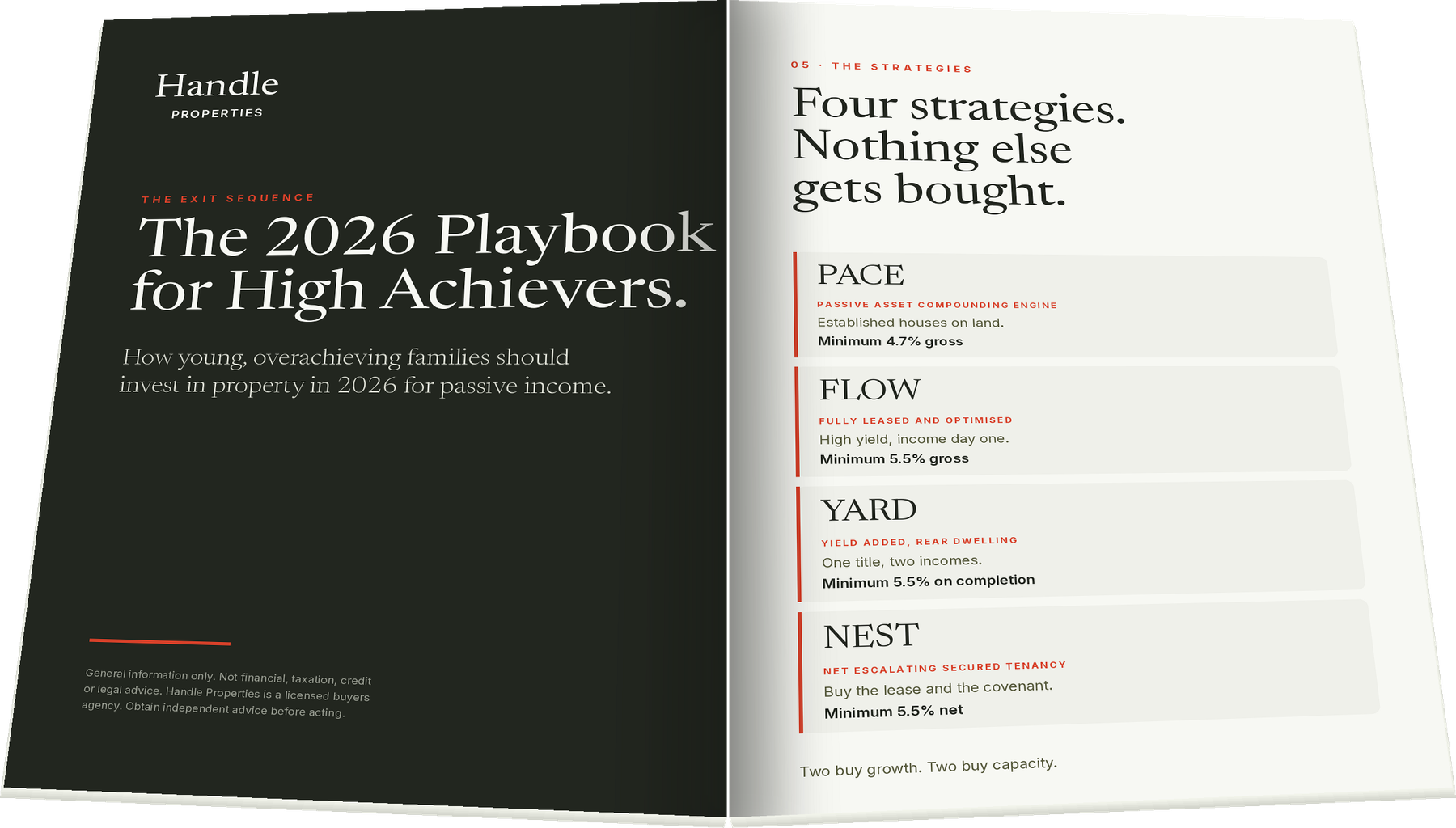
Four strategies with published yield floors
4.7% gross on PACE, 5.5% gross on FLOW, 5.5% on completion for YARD, 5.5% net on NEST. Price bands, timelines and the mistake that kills each one.
The structure map, drawn out
A company per residential position, an SMSF for the commercial. Five walls and no shared fences, what that separation buys you, and what it costs in compliance.
Sixteen settled deals, with the numbers
Real Handle purchases across all four strategies. Purchase price, build cost, added rent, yield on completion and equity uplift, named client by named client.
Six decisions that decide the outcome
Five of the six are made before contracts are signed, which is exactly where the method earns its keep. Plus the full risk register: rate, credit policy, construction, vacancy, liquidity and regulatory, written plainly.
Free. Straight to your inbox.
Who's behind this
We do not teach this. We run it.
Not a research house note written by an analyst who has never signed a contract. This is the method we run before we buy anything for a client, published exactly as it stands, with the deals it has already produced.

Nikhil Sreedhar

Ahijith Chandra
Handle Properties is a residential and commercial buyer's agency. We transact more than $10M of property every month for clients across Australia. Between the two of us we own nineteen properties worth $16m, producing $910k of rent a year, built on salaries. The sequence in this guide is the one we ran ourselves.
140+ families served
Do not take our word for any of it.
Free download
Debt free. Five income streams. No salary required.
That is the modelled destination at years ten to fifteen. Twenty two pages on how the sequence gets there: the order, the structures, sixteen settled deals, and every assumption behind the numbers.
Free. No call required. Unsubscribe any time.

General information only. Not financial, taxation, credit or legal advice. This page and the guide do not take into account your objectives, financial situation or needs, and nothing in either is a recommendation to acquire a particular property or financial product. Chinch Pty Ltd T/A Handle Properties Group is a licensed buyer's agency. We are not financial advisers, tax agents, mortgage brokers, credit providers or legal practitioners.
Sequence outcomes are illustrative and assume rents, values, interest rates and lending policy behave as modelled. They will not behave exactly as modelled. Portfolio values required for a target income are calculated debt free at a 5.5% blended gross yield and exclude acquisition costs, holding costs and tax. Yield floors are targets applied at the point of purchase, not guarantees of achieved return.
Case studies are settled purchases for Handle clients and are past performance examples only. They are not predictive and are not representative of every client outcome. Company and SMSF structures carry compliance costs and trustee obligations, and land tax, CGT, GST and contribution cap treatment differ by structure and by state. Property values, rents, interest rates, lending policy, construction costs and tax settings all change. Obtain independent advice from appropriately licensed professionals before acting.
Free download
The 2026 Playbook for High Achievers
How young, high achieving families invest in property in 2026. Twenty two pages.